Roof carrier
Introduction
Section titled “Introduction”This chapter contains information on the following subjects:
The roof of the vehicle has been optimised for the aerodynamics of the vehicle. Conventional roof bars or carrier bars and carrier systems must not be attached to the water drainage channels.
The water drainage channels are designed to drain water away, so only use roof bars, carrier bars or carrier systems approved by Volkswagen.
When should the mounts or roof bars and load carrier system be removed?
Section titled “When should the mounts or roof bars and load carrier system be removed?”- When it is no longer being used.
- When the vehicle goes through a car wash.
- When the height of the vehicle exceeds the available headroom, for example in a garage.
Additional information and warnings
Section titled “Additional information and warnings”- Exterior views
- Lights
- Transporting
- Environmentally friendly driving
- Wheels and tyres
- Accessories, parts replacement, repairs and modifications
Fitting roof bars or carrier bars and a carrier system also increases fuel consumption, because of the increased wind resistance.
Securing mounts, roof bars or load carrying system
Section titled “Securing mounts, roof bars or load carrying system”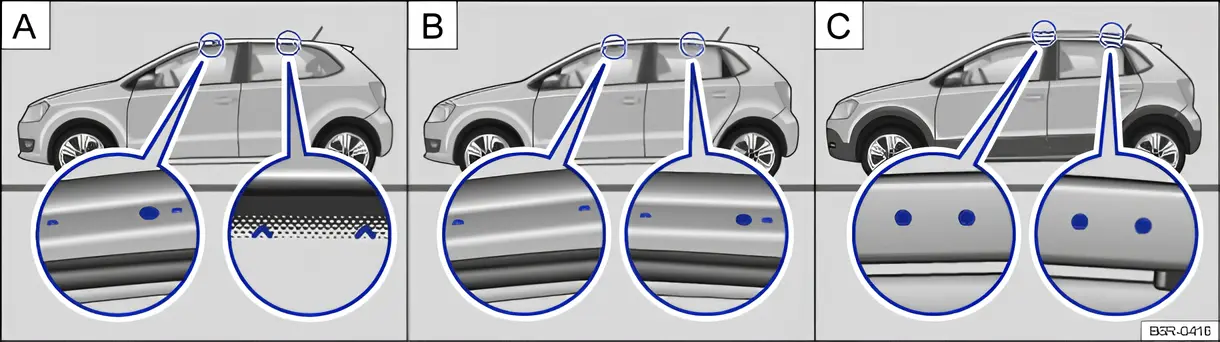
Fig. 91 Attachment points for the roof bars or carrier bars (on both sides; A: 2-door vehicle without roof rails, B: 4-door vehicle without roof rails, C: vehicle with roof rails (Cross Polo))
First read and observe the introductory information and safety warnings .
The roof bars or carrier bars serve as the base for special carrier systems. For safety reasons, suitable carrier systems are required for transporting luggage, bicycles, surfboards, skis and boats. Suitable accessories are available from Volkswagen dealerships.
The roof bars, carrier bars and carrier system must always be fastened correctly. It is essential to read the fitting instructions supplied with the roof bars, carrier bars or carrier system.
Vehicles without roof railings: attaching mounts and load carrier system
Section titled “Vehicles without roof railings: attaching mounts and load carrier system”2-door vehicle: the holes or markings for the attachment points of the front roof bars are located in the lower part of the roof channels ⇒ fig. 91 A (enlargement on the left). The holes or attachment point markings only become visible when the door is opened. The markings for attaching the rear roof bar are located at the top of the side windows ⇒ fig. 91 A (enlargement on the right).
4-door vehicle: the holes or markings for the attachment points of the roof bars are located in the lower part of the roof channels and only become visible when the door is opened ⇒ fig. 91 B.
Only attach the roof carrier at the points marked in the illustration ⇒ .
Once the roof bars have been fitted correctly, attach the carrier system to the roof bars in accordance with the fitting instructions supplied.
Vehicles with roof railings: attaching roof bars and load carrier system
Section titled “Vehicles with roof railings: attaching roof bars and load carrier system”The attachment holes are located on the inside of the roof rail ⇒ fig. 91 C.
Only attach the carrier bars at the points marked in the illustration.
Once the carrier bars have been fitted correctly, attach the carrier system to the carrier bars in accordance with the fitting instructions supplied. Ensure that there is sufficient clearance from the roof aerial, to protect the aerial from damage.
Read and observe the fitting instructions supplied with the roof bars, carrier bars and the corresponding carrier system, and always carry them in the vehicle.
Loading the load carrier system
Section titled “Loading the load carrier system”First read and observe the introductory information and safety warnings .
A load can only be secured properly if the roof bars, carrier bars and carrier system are fitted correctly ⇒ .
Maximum permissible roof load
Section titled “Maximum permissible roof load”The maximum permissible roof load is 75 kg. The roof load is made up of the weight of the carrier system, the roof bars or carrier bars, and the load itself ⇒ .
Always find out the weight of the carrier system, the roof bars or carrier bars and the load being carried, and determine it yourself if necessary. Never exceed the maximum permissible roof load.
If roof bars or carrier bars and a carrier system with a lower load capacity are used, the maximum permissible roof load cannot be used in full. In such cases, the carrier system may only be loaded up to the limit given in the fitting instructions.
Distributing the load
Section titled “Distributing the load”Distribute the load evenly and secure it properly ⇒ .
Checking the fittings
Section titled “Checking the fittings”After fastening the roof bars or carrier bars and the carrier system, check the bolted connections and attachments after a short distance and then at regular intervals.
Useful links: