Wheels and tyres
Introduction
Section titled “Introduction”This chapter contains information on the following subjects:
- Handling wheels and tyres
- Rims
- New wheels and tyres
- Tyre pressure
- Tread depth and wear indicators
- Tyre damage
- Spare wheel or temporary spare wheel
- Tyre lettering
- Winter tyres
- Snow chains
Volkswagen recommends that work on tyres and wheels is carried out by a qualified workshop. They are familiar with the procedure and have the necessary special tools and spare parts and the proper facilities for disposing of the old tyres. Volkswagen recommends using a Volkswagen dealership for this purpose.
Additional information and warnings
Section titled “Additional information and warnings”- Transporting items
- Towing a trailer
- Braking, stopping and parking
- Tyre monitoring system
- Cleaning and caring for the vehicle exterior
- Consumer information
- Vehicle toolkit
- Hubcaps
- Changing a wheel
- Breakdown set
For technical reasons, it is not generally possible to use the wheels from other vehicles. This can also apply to wheels of the same vehicle type. Refer to the vehicle documentation and ask a Volkswagen dealership if necessary.
Useful links:
- Alloy wheels for the Polo 6R
- Steel wheels for the Polo 6R
- Tyres for the Polo 6R
- Genuine hubcaps for the Polo 6R
- Other wheel accessories
- Snow chains and winter accessories
Handling wheels and tyres
Section titled “Handling wheels and tyres”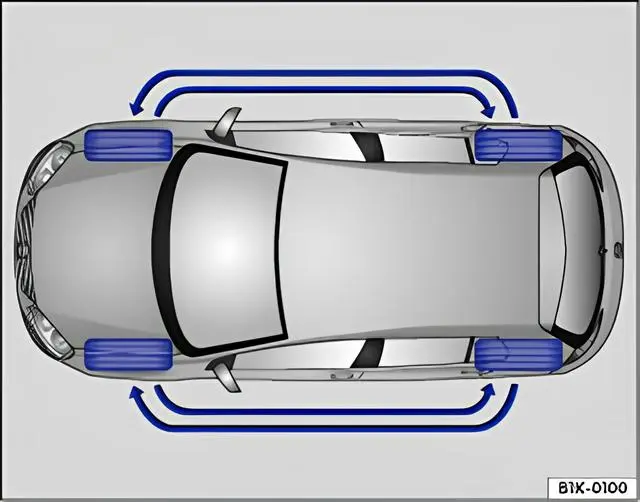
Fig. 147 Diagram showing how to swap wheels
First read and observe the introductory information and safety warnings .
The tyres are the most used and most underestimated parts of a vehicle. Tyres are very important as the narrow tyre surfaces are the only contact between the vehicle and the road.
The service life of tyres is dependent on tyre pressure, driving style handling and fitting.
The tyres and wheel rims are an essential part of the vehicle’s design. The tyres and rims approved by Volkswagen are specifically matched to the characteristics of the vehicle and make a major contribution to good road holding and safe handling.
Avoiding damage to the tyres
Section titled “Avoiding damage to the tyres”- If you have to drive over a kerb or similar obstacle, drive slowly and at a right angle if possible.
- Inspect the tyres regularly for damage such as cuts, cracks or blisters.
- Remove foreign objects that are in the outer tyre tread and have not penetrated the inner tyre ⇒ Spare wheel or temporary spare wheel.
- Always respond to any warning messages given by the tyre monitoring system.
- Damaged or worn tyres must be replaced immediately ⇒ Tyre damage.
- Regularly check the tyres for hidden damage ⇒ Tyre damage.
- Never exceed the top speed and load permitted for the tyres that are fitted ⇒ Tyre lettering.
- Protect the wheels, including the spare wheel, from contact with corrosive substances, including oils, lubricants, fuel and brake fluid ⇒ .
- Replace missing dust caps immediately.
Rotating wheels front to rear
Section titled “Rotating wheels front to rear”Regularly rotating the wheels as shown in the illustration ⇒ fig. 147 is recommended to help ensure that tyres wear evenly. All the tyres will then last for about the same time.
Volkswagen recommends having the wheels changed by a qualified workshop.
Tyres that are older than 6 years
Section titled “Tyres that are older than 6 years”Tyres age through physical and chemical processes that can impair their function. Tyres that are stored unused for an extended period will harden and become brittle more quickly than tyres which are in constant use.
Volkswagen recommends replacing tyres that are older than 6 years with new tyres. This also applies to tyres, including the spare wheel, which appear to still be in good condition and whose tread depth has not yet reached the minimum value stipulated by legislation ⇒ .
The age of a tyre can be determined from the manufacturing date, which is a component of the tyre identification number (TIN) ⇒ Tyre lettering.
Storing tyres
Section titled “Storing tyres”Mark tyres before you remove them to indicate the direction of rotation. This ensures you will be able to mount them correctly when you replace them (left, right, front, rear). When removed, the wheels or tyres should be stored in a cool, dry and preferably dark place. Do not store tyres mounted on the rim vertically.
Any tyres not fitted on rims should be kept in suitable sleeves to protect against dirt and should be stored vertically (standing on the tread).
Old tyres should be disposed of as required by legislation.
First read and observe the introductory information and safety warnings .
The design of the wheel bolts is matched to the rims. If different rims are fitted, the correct wheel bolts with the right length and correctly shaped bolt heads must be used. This ensures that wheels are fitted securely and that the brake system works properly ⇒ Changing a wheel.
For technical reasons, it is not generally possible to use the wheels from other vehicles. This can also apply to wheels of the same vehicle type.
The tyres and rims approved by Volkswagen are specifically matched to the characteristics of the vehicle and make a major contribution to good road holding and safe handling.
Wheel bolts
Section titled “Wheel bolts”Wheel bolts must always be tightened with the correct tightening torque.
Rims with bolted-on rings
Section titled “Rims with bolted-on rings”Rims with bolted-on rings consist of several components. These components are fastened using special bolts and special fastening technology. This ensures that the wheel functions properly, does not leak, remains safe and runs true. For this reason, damaged rims should be replaced. They may only be repaired by a qualified workshop. Volkswagen recommends using a Volkswagen dealership for this purpose ⇒ .
Rims with bolted-on trims
Section titled “Rims with bolted-on trims”Rims may have removable trims that are attached to the rim with self-locking bolts. Damaged trims may only be repaired by a qualified workshop. Volkswagen recommends using a Volkswagen dealership for this purpose ⇒ .
Rims identification
Section titled “Rims identification”In some countries, new rims are legally required to contain certain specifications on them. The following specifications may appear on the rims (varying from region to region):
- Seal of conformity
- Rim size
- Name of manufacturer or brand name
- Date manufactured (month/year)
- Country of origin
- Production number
- Raw materials batch number
- Product code
New wheels and tyres
Section titled “New wheels and tyres”First read and observe the introductory information and safety warnings .
New tyres
Section titled “New tyres”- Drive particularly carefully for the first 600 km with new tyres as the tyres have to be run in. Tyres that have not been run in have reduced grip and braking effect ⇒ .
- All four wheels must be fitted with radial tyres of the same type, size (rolling circumference) and the same tread.
- The tread depth of new tyres may vary, according to the type and make of tyre and the tread pattern.
Replacing tyres
Section titled “Replacing tyres”- Tyres should be replaced at least in pairs and not individually (i.e. both front tyres or both rear tyres together) ⇒ .
- Old tyres should only be replaced by tyres that have been approved by Volkswagen for the vehicle type. Ensure that the tyres used are correct in respect of size, diameter, load-carrying capacity and maximum speed.
- Never use tyres with an effective size that is larger than Volkswagen-approved tyres. Larger wheels could rub against the body or other parts of the vehicle.
Additional information for vehicles with a Tyre Pressure Loss Indicator
Section titled “Additional information for vehicles with a Tyre Pressure Loss Indicator”On vehicles with a Tyre Pressure Loss Indicator, the system will have to relearn every time a new wheel is fitted, regardless of whether the wheel in question is being fitted in the same or in a different position ⇒ Tyre monitoring system.
Further information about the tyre monitoring system, how it functions and what you must know ⇒ Tyre Pressure Loss Indicator.
Despite identical size markings, the effective size of different tyre types can differ from the nominal size or the tyre contour can be considerably larger.
With Volkswagen-approved tyres, it is certain that the effective tyre sizes have been matched to the vehicle. With other tyre types, the dealer must provide a certificate from the tyre manufacturer confirming that the tyre type is also suitable for the vehicle. Keep this certificate and carry it in the vehicle.
Tyre pressure
Section titled “Tyre pressure”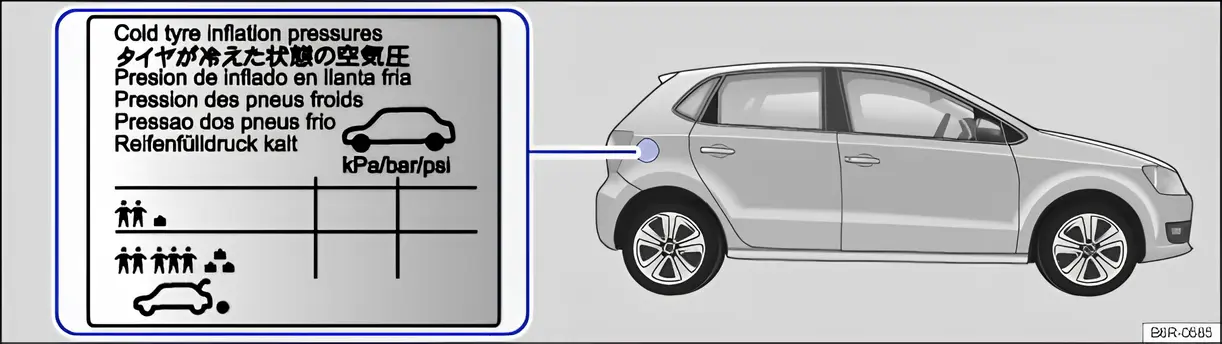
Fig. 148 On the inside of the tank flap: tyre inflation pressure label
First read and observe the introductory information and safety warnings .
The correct tyre pressure for factory-fitted tyres is shown on a sticker and applies to all-season, summer and winter tyres. The sticker ⇒ fig. 148 is located on the inside of the tank flap.
If the tyre pressure is too low or too high, the tyres will wear prematurely and the vehicle will not handle well ⇒ . The correct tyre pressure is particularly important at high speeds. Incorrect tyre pressure causes premature wear and can cause a tyre burst.
The pressure should therefore be checked at least once a month and before starting a journey.
The given tyre pressure applies to cold tyres. Tyre pressure is always higher in warm tyres than it is in cold tyres.
For this reason, never reduce the pressure in warm tyres to adjust the tyre pressure. This would result in low tyre pressures that could cause the tyre to burst suddenly.
Checking tyre pressure
Section titled “Checking tyre pressure”Only check the tyre pressure when the tyres have not been driven for more than a few kilometres at low speed in the last three hours.
- The tyre pressures should be checked regularly and only when the tyres are cold. Always check all the tyres, including the spare if fitted. The tyre pressure should be checked at more regular intervals in colder regions, but only if the vehicle has not been moved beforehand. The tyre pressure tester must function correctly.
- The tyre pressures must be altered to suit the vehicle load.
- After altering the tyre pressures, please ensure that the valve caps are screwed on and observe any information and instructions on setting the tyre monitoring system.
- Note that it is the vehicle manufacturer, not the tyre manufacturer, that specifies the tyre pressures. Never exceed the maximum tyre pressure marked on the tyre sidewall.
The spare wheel or temporary spare wheel are filled to the highest tyre pressure permissible for the vehicle.
Under-inflated tyres can contribute to an increase in fuel consumption.
If the tyre monitoring display warns that the tyre pressure in at least one tyre is too low, check tyre pressures with a functioning tyre pressure tester. Low tyre pressure cannot be determined exclusively by looking at the tyre. This also applies to tyres with a low profile.
Please refer to the special points of the tyre monitoring system when checking tyre pressures.
Tread depth and wear indicators
Section titled “Tread depth and wear indicators”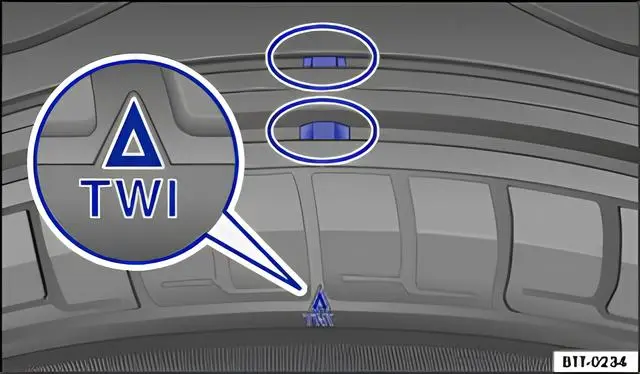
Fig. 149 Tyre tread: wear indicators
First read and observe the introductory information and safety warnings .
Tread depth
Section titled “Tread depth”Difficult driving situations demand the deepest possible tread depth for the tyres and the same tread depth for the tyres on the front and rear axles. This applies in particular for driving in winter weather and cold temperatures and in wet conditions ⇒ .
In most countries, the minimum tread depth required by law is 1.6 mm (measured in the tread grooves next to the tread wear indicators). Observe any country-specific legal requirements.
Winter tyres lose a large degree of their effectiveness when the tread is worn down to a depth of 4 mm.
The tread depth of new tyres can vary according to type and manufacturer due to construction and tread design.
Tread wear indicator in tyres
Section titled “Tread wear indicator in tyres”The original tyres on your vehicle have 1.6 mm high tread wear indicators running across the tread ⇒ fig. 149. These wear indicators are positioned at set intervals around the tyre. Markings on the tyre sidewall (for instance the letters TWI or other symbols) indicate the positions of the tread wear indicators.
The tread wear indicators show if a tyre is worn down. The tyre must be replaced at the latest when the tread depth is just down to the tread wear indicator.
Tyre damage
Section titled “Tyre damage”First read and observe the introductory information and safety warnings .
Damage to tyres and rims is often not readily visible. Any unusual vibrations or signs that the car is pulling to one side may indicate that one of the tyres is damaged ⇒ .
- Reduce your speed immediately if you suspect that a wheel is damaged.
- Check the tyres and rims for damage.
- If the tyre is damaged, do not drive on. Seek expert assistance.
- If there is no visible damage, drive slowly and cautiously to the next qualified workshop in order to have the vehicle checked.
Foreign bodies in the tyre
Section titled “Foreign bodies in the tyre”- Leave the foreign body in the tyre if it has entered the inner tyre. However, foreign bodies that are stuck between the tyre tread blocks can be removed.
- For vehicles with a spare wheel or temporary spare wheel: where appropriate, change the damaged wheel ⇒ Changing a wheel. If required, seek expert assistance when changing the damaged wheel. Volkswagen recommends using a Volkswagen dealership for this purpose.
- For vehicles with a breakdown set: if required, seal the tyre and pump it up using the breakdown set ⇒ Breakdown set. Go to a qualified workshop. Volkswagen recommends using a Volkswagen dealership for this purpose.
- Check the pressure and adjust it as required.
Tyre wear
Section titled “Tyre wear”Tyre wear is affected by several factors. These include:
- Driving style.
- Unbalanced wheels.
- Running gear setting.
Driving style - fast cornering, heavy acceleration and hard braking all increase tyre wear. The running gear should be checked by a qualified workshop if the tyres show excessive wear despite a normal driving style.
Unbalanced wheels - the wheels on new vehicles are balanced. However, various factors encountered in normal driving can cause them to become unbalanced, which results in steering vibration. Unbalanced wheels will affect levels of wear on the steering system and the suspension. In this case the wheels should be balanced again. New tyres have to be balanced after fitting.
Running gear setting - incorrect wheel alignment causes excessive tyre wear, impairing the safety of the vehicle. The wheel alignment should be checked by a qualified workshop if tyres show excessive wear.
Spare wheel or temporary spare wheel
Section titled “Spare wheel or temporary spare wheel”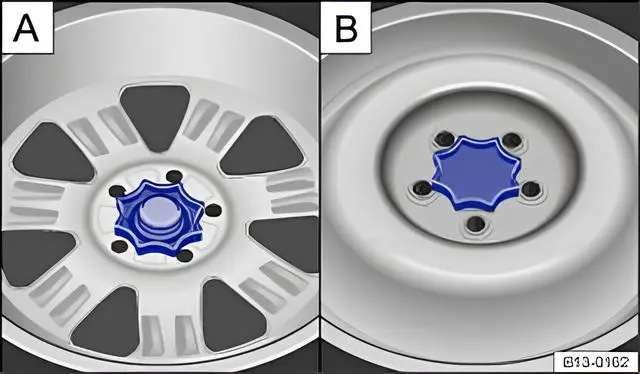
Fig. 150 In the luggage compartment: variant A: handwheel for securing the spare wheel; variant B: handwheel for securing the temporary spare wheel
First read and observe the introductory information and safety warnings .
Removing the spare wheel
Section titled “Removing the spare wheel”- Open the tailgate then lift up and secure the variable load surface as required ⇒ Luggage compartment.
- Hook the floor covering onto the top edge of the luggage compartment.
- Remove the toolbox ⇒ Vehicle toolkit.
- Completely unscrew the handwheel in the middle of the spare wheel ⇒ fig. 150 A or the temporary spare wheel B anticlockwise and remove the spare wheel or temporary spare wheel.
Storing the removed wheel
Section titled “Storing the removed wheel”- Open the tailgate then lift up and secure the variable load surface as required.
- Hook the floor covering onto the top edge of the luggage compartment.
- Place the removed wheel into the spare wheel well with the rim facing downwards with the central hole in the rim positioned exactly above the stud.
- Turn the handwheel clockwise on the stud until the wheel is secured firmly.
- If necessary, place the vehicle toolkit back in the container in the luggage compartment.
- Unhook the floor covering and place it back on the luggage compartment floor.
- Close the tailgate.
If the spare wheel tyre is not the same as the tyres that are mounted on the vehicle
Section titled “If the spare wheel tyre is not the same as the tyres that are mounted on the vehicle”If the spare wheel is not the same as those mounted on the vehicle - for example if winter tyres or the temporary spare wheel are fitted - only use the spare wheel for a short period of time and drive with extra care ⇒ .
Refit the normal, functional road wheel as soon as possible.
Follow these driving guidelines
Section titled “Follow these driving guidelines”- Do not drive faster than 80 km/h (50 mph).
- Avoid full acceleration, sudden braking and fast driving through bends in the road.
- Do not use snow chains on the temporary spare wheel ⇒ Snow chains.
- The tyre pressure must be checked as soon as possible after fitting the spare wheel or temporary spare wheel ⇒ Tyre pressure.
The tyre pressure of the spare wheel or temporary spare wheel should be checked together with the normal tyres, at least once a month. The spare wheel should have the highest pressure allowed for the vehicle ⇒ Tyre pressure. The tyre pressure for the temporary spare wheel can be found on the sticker on the temporary spare wheel.
If possible, stow the spare wheel, temporary spare wheel or the removed wheel safely in the luggage compartment. In vehicles with a breakdown set, the removed wheel cannot be secured.
Tyre lettering
Section titled “Tyre lettering”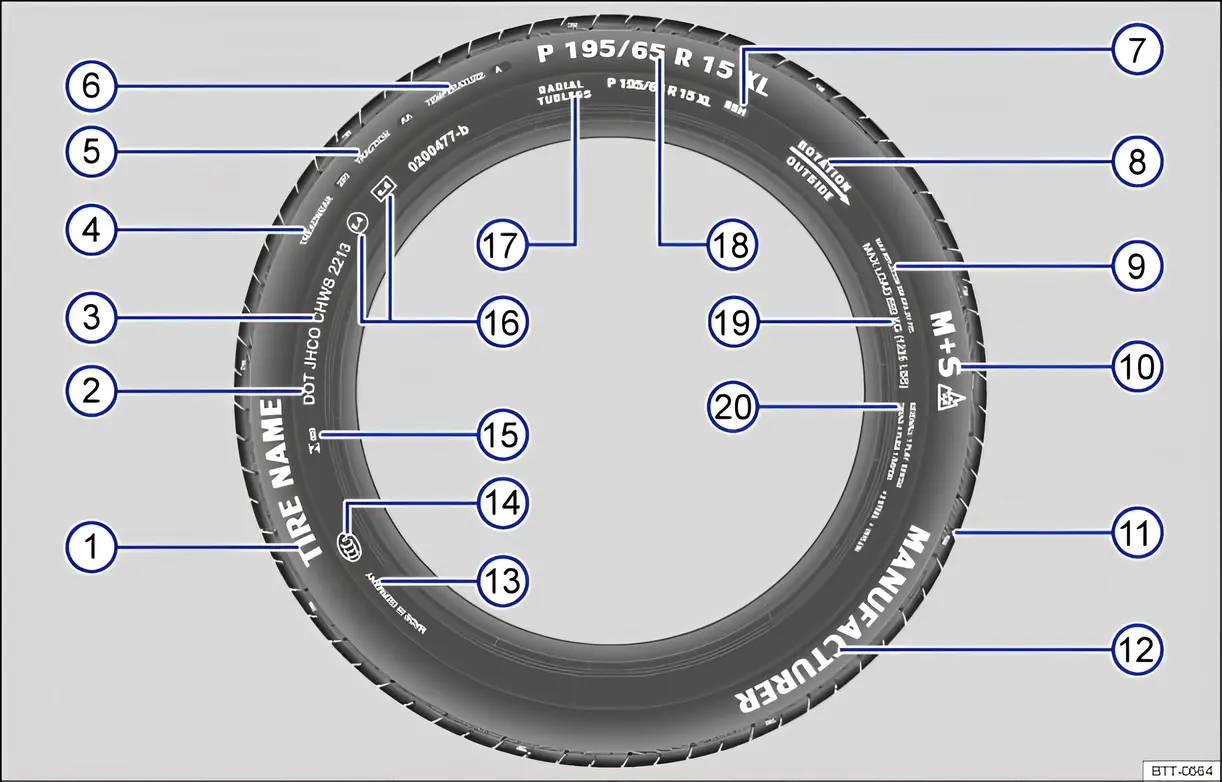
Fig. 151 International tyre lettering
First read and observe the introductory information and safety warnings .
| ⇒ fig. 151 | Tyre lettering (example) | Meaning | |
|---|---|---|---|
| 1 | Product name | The manufacturer’s individual designation for the tyre. | |
| 2 | DOT | The tyre complies with the requirements of the US Department of Transportation, which is responsible for tyre safety standards. | |
| 3 | JHCO CHWS 2213 | Tyre identification number (TINa) - may be on the inner side of the wheel only) and date of manufacture: | |
| JHCO CHWS | Code for the manufacturing plant and the tyre manufacturer’s details on tyre size and characteristics. | ||
| 2213 | Date of manufacture: 22nd week of 2013. | ||
Information for end users on the comparative values of the tyres listed, based on a standardised test method ⇒ Consumer information: | |||
| 4 | TREADWEAR 280 | Relative life expectancy for the tyre, with reference to a US-specific standard test. A tyre with the specification 280 wears 2.8 times more slowly than a normal tyre with a Treadwear value of 100. The relative performance of the tyre depends on the actual operating conditions and can deviate considerably from the norm on account of driving style, maintenance, differences in road surfaces and climate. | |
| 5 | TRACTION AA | The tyre’s braking ability on wet roads (AA, A, B or C). It is measured under controlled conditions on certified test tracks. A tyre marked C has a low level of traction. The traction value assigned to the tyre is based on a straight-line traction test and covers neither acceleration, cornering, aquaplaning nor traction under maximum load. | |
| 6 | TEMPERATURE A | The tyre’s temperature resistance at high speeds on a test rig (A, B or C). Tyres marked A and B exceed the legal requirements. The temperature rating is based on tyres with the correct tyre pressure and excludes overloading. Excessive speed, incorrect tyre pressure and overloading can, alone or in combination, cause the tyre to overheat or be damaged. | |
| 7 | 88 H | Load rating and speed index. | |
| 8 | Rotation and arrow | Marking for the tyre’s direction of rotation ⇒ Tyres with directional tread pattern. | |
| OR: Outside | Marking for the outer side of the tyre ⇒ Asymmetric tyres. | ||
| 9 | MAX INFLATION 350 KPA (51 psi / 3.51 bar) | US limit for maximum tyre pressure. | |
| 10 | M+S or M/S or | Marking for tyres used in winter (mud and snow tyres) ⇒ Winter tyres. Studded tyres carry the letter E after the S symbol. | |
| 11 | TWI | Indicates the position of the tread wear indicator. | |
| 12 | Brand, logo | Manufacturer. | |
| 13 | Made in Poland | Country of manufacture. | |
| 14 | Country-specific marking for China (China Compulsory Certification). | ||
| 15 | 023 | Country-specific marking for Brazil (Brazil Inmetro Certification). | |
| 16 | E4 e4 0200477-b | Marking in accordance with international regulations, with the approval country number. Tyres approved under the ECE regulation carry the symbol E, tyres approved under the EC regulation the symbol e, followed by a multi-digit approval number. | |
| 17 | RADIAL TUBELESS | Tubeless radial tyres. | |
| 18 | P 195 / 65 / R 15 XL | Size marking | |
| P | Marking for passenger cars. | ||
| 195 | Tyre width from one sidewall to the other in mm. | ||
| 65 | Ratio of height to width as a percentage. | ||
| R | Letter code for the belt type of radial tyres. | ||
| 15 | Rim diameter in inches. | ||
| XL | Reinforced tyres. | ||
| 19 | MAX LOAD 615 KG (1235 LBS) | US load specification for the maximum load per wheel. | |
| 20 | SIDEWALL 1 PLY RAYON | Details of the material in the tyre sidewall: 1 ply rayon. | |
| TREAD 4 PLIES 1 RAYON + 2 STEEL + 1 NYLON | Details of the material in the tyre tread: in this example there are 4 plies under the tread, 1 ply rayon, 2 plies steel belt and 1 ply nylon. | ||
The tyre lettering also appears on the inner side of the tyre. Certain markings, e.g. the tyre identification number and the date of manufacture, may appear on one side of the tyre only.
Any further characters are internal markings used by the tyre manufacturer or country-specific markings.
Tyres with directional tread pattern
Section titled “Tyres with directional tread pattern”Tyres with directional tread pattern have been developed to roll in one direction only. An arrow on the tyre sidewall indicates the direction of rotation on tyres with directional tread. The direction of rotation must be adhered to. This is the only guarantee for optimum grip and helps to avoid aquaplaning, excessive noise and wear.
If, however, the tyre is fitted in the opposite direction to the tread pattern, you must take more care when driving as the tyre is now no longer being used according to its designation. This is particularly important on wet roads. The tyres must be replaced as quickly as possible or be fitted with the tread in the correct direction.
Asymmetric tyres
Section titled “Asymmetric tyres”Asymmetric tyres take account of the different behaviour of the inner and outer zones of the tread pattern. On asymmetric tyres the sidewall is marked to show the inner and outer sides. The position of the tyre on the rim must be adhered to. This is the only guarantee for optimum grip and helps to avoid aquaplaning, excessive noise and wear.
If, however, the tyre is fitted the wrong way round, you must take more care when driving as the tyre is now no longer being used according to its designation. This is particularly important on wet roads. The tyres must be replaced as quickly as possible or be fitted the correct way round.
Tyre load rating
Section titled “Tyre load rating”The tyre load rating indicates the maximum load in kilograms that a single tyre can carry.
Some examples:
| 78 | 425 kg |
| 81 | 462 kg |
| 83 | 487 kg |
| 85 | 515 kg |
| 87 | 545 kg |
| 88 | 560 kg |
| 91 | 615 kg |
Speed index
Section titled “Speed index”The speed index indicates the maximum speed at which the tyre may be driven.
| P | max. 150 km/h (93 mph) |
| Q | max. 160 km/h (99 mph) |
| R | max. 170 km/h (106 mph) |
| S | max. 180 km/h (112 mph) |
| T | max. 190 km/h (118 mph) |
| U | max. 200 km/h (125 mph) |
| H | max. 210 km/h (130 mph) |
| V | max. 240 km/h (149 mph) |
| Z | over 240 km/h (149 mph) |
| W | max. 270 km/h (168 mph) |
| Y | max. 300 km/h (186 mph) |
Some manufacturers use the letter combination “ZR” for tyres with a permissible maximum speed above 240 km/h (149 mph).
Winter tyres
Section titled “Winter tyres”First read and observe the introductory information and safety warnings .
In winter road conditions, winter tyres will considerably improve the car’s handling. The design of summer tyres (width, rubber compound, tread pattern) gives less grip on ice and snow. Volkswagen urgently recommends the use of winter tyres or all-year tyres on all four wheels of the vehicle, particularly if winter conditions are expected on the roads. Winter tyres will also improve the braking response of the vehicle and will help to reduce braking distances in winter weather. Volkswagen recommends that winter tyres be fitted to the vehicle at temperatures below +7 °C (+45 °F).
Winter tyres lose their effectiveness when the tread is worn down to a depth of 4 mm. Winter tyres also largely lose their effectiveness through ageing - regardless of the tread depth.
The following applies when using winter tyres
Section titled “The following applies when using winter tyres”- Observe any country-specific legal requirements.
- Use winter tyres on all four wheels at the same time.
- Only use in winter road conditions.
- Only use the sizes of winter tyre that have been approved for the vehicle.
- Winter tyres must have the same type, size (rolling circumference) and the same tread pattern.
- Heed the maximum speed permitted by the speed index.
Speed limitation
Section titled “Speed limitation”Winter tyres have a speed limitation depending on the speed index ⇒ Speed index.
In some vehicle versions, a speed warning can be set in the MFD (multifunction display) menu in the instrument cluster ⇒ Settings menu.
If you use V-rated tyres the speed limits and required tyre pressure will be determined by the engine size. You must ask a Volkswagen dealership about the highest permitted speed and required tyre pressure.
Summer tyres should be fitted in good time at the end of the winter. The vehicle handling is better if summer tyres are fitted at temperatures above +7 °C (+45 °F). They are quieter, do not wear so quickly and reduce fuel consumption.
In vehicles with a Tyre Pressure Loss Indicator, the system has to re-learn after wheels are changed ⇒ Tyre monitoring system.
Volkswagen dealerships can provide details on permissible winter tyre sizes.
Snow chains
Section titled “Snow chains”First read and observe the introductory information and safety warnings .
Please heed legislation and also the permitted speed when driving your vehicle with snow chains.
In winter conditions, snow chains will not only improve acceleration, but also braking response.
Snow chains may be fitted only to the front wheels. They may be fitted only to the following tyre and wheel combinations:
| Tyre size | Wheel |
|---|---|
| 175/70 R 14 | 5 J x 14 offset 35 |
| 185/60 R 15 | 6 J x 15 offset 38 |
| 185/60 R 15 | 6 J x 15 offset 40 |
| 195/55 R 15 | 6 J x 15 offset 40 |
| 195 / 50 R 16 | 6 J x 16 offset 40 |
Volkswagen recommends that you ask your Volkswagen dealership for information about appropriate wheel, tyre and snow chain size.
If possible, use snow chains with fine-pitch links which do not protrude more than 15 mm, including the tensioner.
Remove wheel centre covers and trim rings before fitting snow chains ⇒ . For safety reasons cover caps must then be fitted over the wheel bolts. These are available from your Volkswagen dealership.
Temporary spare wheel
Section titled “Temporary spare wheel”For technical reasons, snow chains must not be used on the temporary spare wheel ⇒ Spare wheel or temporary spare wheel.
If you have to use snow chains with the temporary spare wheel fitted, the temporary spare wheel should be fitted to the rear axle even when a front wheel is damaged. You can then use the wheel taken from the rear axle to replace the damaged front wheel. Please note the direction of rotation. Volkswagen recommends fitting the snow chains before mounting the wheel on the car.
Snow chains for the vehicle type are available in various sizes.