Tyre monitoring system (TPMS)
The tyre monitoring system, TPMS for short (Tyre Pressure Monitoring System), also known as RKA/RKD (German Reifenkontrollanzeige / Reifendruckkontrolle).
Introduction
Section titled “Introduction”This chapter contains information on the following subjects:
Additional information and warnings
Section titled “Additional information and warnings”- Volkswagen information system
- Transporting items
- Braking, stopping and parking
- Cleaning and caring for the vehicle exterior
- Wheels and tyres
- Accessories, modifications, repairs and renewal of parts
- Consumer information
Under-inflated tyres will increase fuel consumption and tyre wear.
When new tyres are driven at high speeds for the first time, they can expand slightly and trigger a one-off pressure warning.
Old tyres should only be replaced by tyres that have been approved by Volkswagen for the vehicle type.
Do not rely solely on the tyre monitoring system. Check your tyres regularly to ensure that they are properly inflated and have no signs of damage, such as punctures, cuts, cracks, and blisters. Remove any objects that become embedded in the tyre tread but have not penetrated into the body of the tyre itself.
Indicator lamp for the tyre monitoring system
Section titled “Indicator lamp for the tyre monitoring system”Lit up | Possible cause | Solution |
|---|---|---|
| The tyre pressure of one tyre or several tyres has decreased considerably in comparison to the tyre pressure set by the driver, or the structure of the tyre is damaged. An acoustic warning is also given. | Do not drive on! | |
| System faulty. The indicator lamp lights up permanently. No warning signal is given. | If the tyre pressure is correct but the indicator lamp fails to go out after the ignition is switched off and back on again, and if it is not possible to synchronise the tyre monitoring system, please go to a qualified workshop. The system must be checked. |
Several warning and indicator lamps will light up briefly as a functional check when the ignition is switched on. They will switch off after a few seconds.
If the tyre pressure is too low and this is detected when the ignition is switched on, an acoustic warning is emitted. If a system fault is detected, no signal tone is given.
Driving on unpaved roads for long periods, or a sporty driving style, can temporarily deactivate the Tyre Pressure Loss Indicator. The indicator lamp shows the functional fault, but disappears if the road conditions or driving style change.
Tyre Pressure Loss Indicator
Section titled “Tyre Pressure Loss Indicator”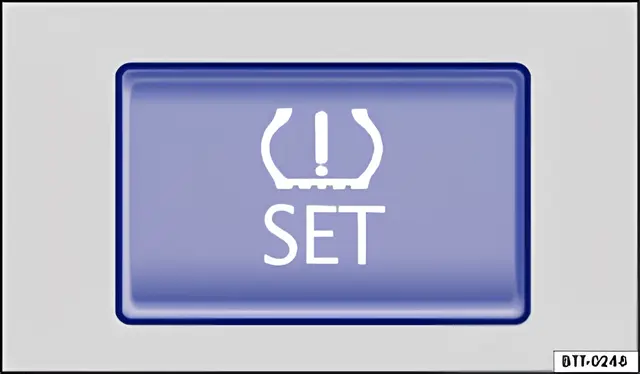
Fig. 126 In the stowage compartment on the front passenger side: button for the Tyre Pressure Loss Indicator
First read and observe the introductory information and safety warnings .
The Tyre Pressure Loss Indicator uses data from the ABS sensors and other functions to check the speed of rotation and the rolling circumference of the individual wheels. Any change in the rolling circumference of one or more wheels is shown by the Tyre Pressure Loss Indicator in the instrument cluster.
Changes in the rolling circumference
Section titled “Changes in the rolling circumference”The rolling circumference of a tyre can change:
- If the tyre pressure has been changed manually.
- If the tyre pressure is too low.
- If the tyre has structural damage.
- If the vehicle is loaded more heavily on one side.
- If the wheels on one axle are loaded more heavily, e.g. high load level.
- If snow chains have been fitted.
- If a temporary spare wheel has been fitted.
- If one wheel per axle has been changed.
In certain circumstances, the Tyre Pressure Loss Indicator may become slow or may not display anything, e.g. with a sporty driving style, in winter driving conditions, on unpaved roads, or when driving with snow chains.
Calibrating the Tyre Pressure Loss Indicator
Section titled “Calibrating the Tyre Pressure Loss Indicator”The Tyre Pressure Loss Indicator will have to be re-synchronised after changing the tyre pressure, or after changing one or more wheels. This also applies when wheels are swapped, e.g. from the front to the rear.
- Switch on the ignition.
- Press and hold the button ⇒ fig. 126 until an acoustic confirmation signal is emitted.
During normal vehicle operation, the system calibrates itself independently to the fitted tyres and the tyre pressures filled by the driver. The calibrated values are stored and monitored after a long journey at various speeds.
If the wheels are loaded more heavily than normal, e.g. if the vehicle is carrying heavy payload, the tyre pressure must be raised to the recommended full-load tyre pressure before synchronisation ⇒ Wheels and tyres.
The Tyre Pressure Loss Indicator stops working if there is a fault in the ESC or ABS ⇒ Braking, stopping and parking.
If a warning is given about tyre pressure being too low, the vehicle must remain stationary for approximately one minute and should not be moved.
Alternatively, the ignition can be switched off and then back on again. Only then can the Tyre Pressure Loss Indicator be synchronised using the tyre monitoring button ⇒ fig. 126.
When using snow chains, an incorrect display may be shown as the snow chains increase the tyre circumference.