Fuel
Introduction
Section titled “Introduction”This chapter contains information on the following subjects:
Different engines require different fuels. The factory-fitted sticker on the inside of the tank flap indicates the fuel type that is required for your particular vehicle.
Volkswagen recommends using low-sulphur or sulphur-free fuels, to help reduce fuel consumption and prevent damage to the engine.
If the engine is not running smoothly or begins to judder, this can indicate poor or inadequate fuel quality, e.g. water in the fuel. If these symptoms appear, reduce the vehicle speed immediately and drive to the nearest qualified workshop at medium engine speeds, avoiding high engine loading. If these symptoms occur immediately after the vehicle has been refuelled, switch the engine off as soon as it is safe to do so and seek expert assistance. This can help to prevent further damage.
Additional information and warnings
Section titled “Additional information and warnings”- ⇒ booklet Service schedule
- Filling the tank
- Engine management and exhaust system
Petrol
Section titled “Petrol”First read and observe the introductory information and safety warnings .
Petrol types
Section titled “Petrol types”Vehicles with a petrol engine must be run on unleaded petrol in compliance with the European standard EN 228 ⇒ . Fuels with a maximum ethanol content of 10% (E10) can be used for refuelling.
Petrol types are categorised according to their octane number, e.g. 91, 95, 98 or 99 RON.
RON = research octane number.
The vehicle may be filled with petrol that has a higher octane number than the engine requires. However, this does not provide any advantage in terms of fuel consumption or engine output. Where petrol complying with the EN 228 standard is not available, Volkswagen dealerships and filling stations will have information on which fuels do comply with the EN 228 standard.
Volkswagen recommends using fuel with a low sulphur content or sulphur-free fuel for petrol engines in order to achieve reduced fuel consumption.
Petrol additives
Section titled “Petrol additives”The quality of petrol influences the running properties, performance and service life of the engine. This is why the vehicle should be refuelled with good quality petrol that has only non-metallic additives pre-added by the petroleum industry. These petrol additives help to prevent corrosion, keep the fuel system clean, and prevent the build-up of deposits in the engine.
If good quality petrol containing non-metallic additives is not available, or if engine problems arise, the necessary petrol additives must be added to the petrol when refuelling ⇒ .
Volkswagen recommends genuine Volkswagen or Audi fuel additives for petrol engines. These additives and information on how to use them are available from your Volkswagen dealership.
Not all petrol additives are effective. The use of unsuitable petrol additives can cause considerable damage to the engine and catalytic converter. Metallic additives should be avoided at all times.
Petrol additives on sale that are intended to improve knock resistance or increase the octane number can also contain metallic additives ⇒ .
Diesel
Section titled “Diesel”First read and observe the introductory information and safety warnings .
Diesel
Section titled “Diesel”Diesel fuel must comply with the European standard EN 590 (in Germany DIN EN 590) ⇒ .
The service intervals are shorter if you use diesel with a high sulphur content ⇒ booklet Service schedule ⇒ . A Volkswagen dealership will be able to tell you which countries have diesel with a high sulphur content.
Where diesel fuel complying with the EN 590 standard is not available, Volkswagen dealerships and filling stations will have information on which fuels do comply with the EN 590 standard.
Do not mix fuel additives (thinners, or similar additives) with diesel fuel.
Winter diesel
Section titled “Winter diesel”When using summer-grade diesel, difficulties may be experienced at temperatures below 0°C (+32°F) because the fuel thickens due to paraffin separation. For this reason winter-grade diesel is available in countries such as Poland and Germany during the cold months. It can be used at temperatures lower than -20°C (-4°F).
In countries with different climatic conditions the diesel sold generally has different temperature characteristics. Check with a Volkswagen dealer or filling stations in the country concerned regarding the type of diesel fuels available.
It is not unusual for a cold diesel engine to be louder in cold temperatures than in warm weather. In addition, exhaust emissions may be tinged with blue while the engine starts and reaches operating temperature. The amount of exhaust fumes depends on the outside temperature.
Filter preheater
Section titled “Filter preheater”Diesel vehicles are equipped with a filter pre-heater system. This ensures that the fuel system remains operational even down to approximately -15°C (+5°F) provided that winter-grade diesel which is safe down to -24°C (-11.2°F) is used.
However, if the fuel has waxed to such an extent that the engine will not start at temperatures below -24°C (-11.2°F) simply place the vehicle in a warm garage or workshop for a while.
Autogas
Section titled “Autogas”a) Polo 6R 1.4 BiFuel CMAA (03/2010–06/2010)
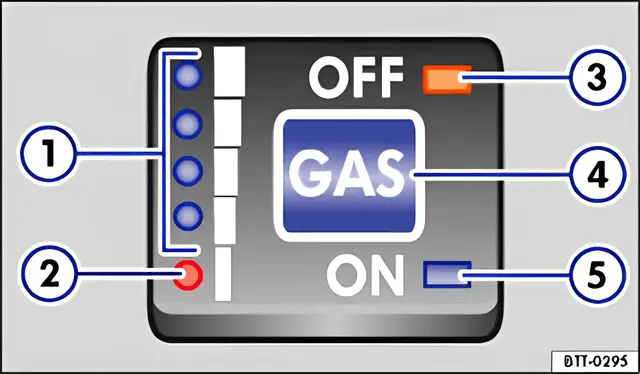
Fig. 135 a) In the centre console: fuel gauge and the switch for autogas mode.
First read and observe the introductory information and safety warnings .
- Autogas level gauge
- Reserve lamp
- Indicator lamp off (petrol mode)
- Autogas changeover button
- Indicator lamp lit (autogas mode)
b) Polo 6R 1.6 BiFuel CNKA (01/2011–03/2014)
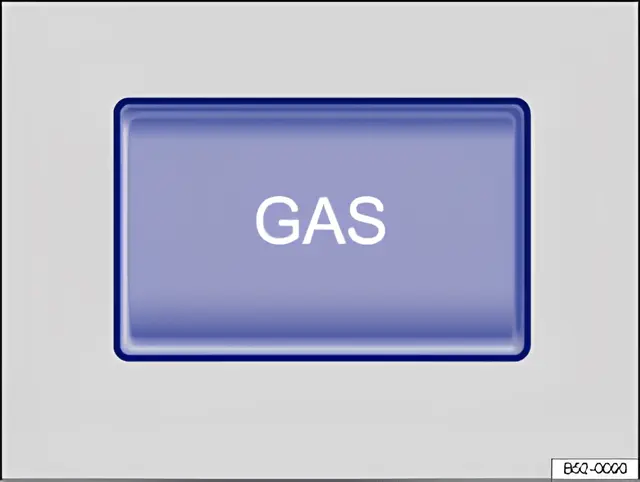
Fig. 135 b) In the upper section of the centre console: switch for Autogas
First read and observe the introductory information and safety warnings .
When the vehicle is restarted, the last manually selected operating mode will be adopted automatically. If, for example, autogas mode was activated manually, the engine initially starts in petrol mode but automatically changes over to autogas mode as soon as the conditions for autogas mode are fulfilled.
Switching on autogas mode
Section titled “Switching on autogas mode”- Press the GAS button.
After a system check, the engine switches from petrol mode to autogas mode, if the following conditions are fulfilled:
- There is sufficient autogas in the autogas tank.
- The engine coolant has reached the temperature necessary for autogas mode.
- The ambient temperature required for autogas mode is reached.
- Engine speed greater than 1,200 rpm.
- A test of the autogas system is completed and the prescribed waiting time has expired. (This procedure can take several minutes.)
- No faults are detected during the system test.
a) Polo 6R 1.4 BiFuel CMAA (03/2010–06/2010)
The OFF indicator lamp lights up.
Petrol mode is switched on automatically when the engine is started, or when one of the conditions for autogas mode is no longer fulfilled. The ON indicator lamp flashes. As soon as the conditions are fulfilled again, autogas mode is resumed.
b) Polo 6R 1.6 BiFuel CNKA (01/2011–03/2014)
The green indicator lamp of the autogas gauge lights up.
Switching on petrol mode
Section titled “Switching on petrol mode”- Press the GAS button.
The green indicator lamp of the autogas gauge goes out.
Petrol mode is automatically switched on if the engine is started or if one of the conditions for autogas mode is no longer fulfilled. As soon as the conditions are fulfilled again, the autogas mode is restarted the next time the engine is switched on.
Autogas system fault
Section titled “Autogas system fault”a) Polo 6R 1.4 BiFuel CMAA (03/2010–06/2010)
| Instrument cluster display | Action |
|---|---|
| (OFF) lights up and the lamps flash. A warning tone sounds at short intervals. | Press the GAS changeover button ⇒ fig. 135 a) 4 to switch the warning tone off. Go to a qualified workshop to have the system checked immediately. |
b) Polo 6R 1.6 BiFuel CNKA (01/2011–03/2014)
| Instrument cluster display | Action |
|---|---|
Fault: LPG Workshop! | Go to a qualified workshop to have the system checked immediately. |
Gas mode currently not possible. Owner’s manual! | Check whether all requirements for autogas mode have been met ⇒ Autogas. If so, go to a qualified workshop where the system should be checked immediately. |
Petrol mode currently not possible. Owner’s manual! | Go to a qualified workshop to have the system checked immediately. |
Autogas quality and consumption
Section titled “Autogas quality and consumption”Quality standards for autogas are governed throughout Europe by the DIN EN 589 standard. Autogas can therefore be used without problems in the whole of Europe.
Autogas is a blend of propane and butane.
There is a difference between winter gas and summer gas. Winter gas contains a higher percentage of propane. This can result in winter gas being less efficient (higher consumption) than summer gas.
The vehicle engine management automatically adapts to the type of autogas being used. Both types of autogas can therefore be mixed in the fuel tank. You do not need to empty the tank before refuelling with a different grade.
Safe handling of autogas
Section titled “Safe handling of autogas”If you can smell gas or think there may be a leak in the autogas system ⇒ :
- Stop the vehicle immediately.
- Switch off the ignition.
- Open all the doors to fully ventilate the vehicle.
- Extinguish cigarettes immediately.
- Remove items that could cause sparks or fire from the vehicle or switch them off.
- Do not drive on if you can still smell gas.
- Seek expert assistance. Have the fault rectified.
Have the autogas system checked regularly by a qualified workshop in accordance with the service schedule.
The engine always starts in petrol mode - even if the engine was stopped in autogas mode. For this reason, the petrol tank should never be allowed to become completely empty.
If you make regular short trips with the vehicle, particularly at low outside temperatures, the vehicle will use the petrol mode more frequently than the autogas mode. This will mean that the petrol tank will empty more quickly than the autogas tank.
In vehicles with warning and information text displays, information about autogas mode can appear in the instrument cluster.