Coolant
Introduction
Section titled “Introduction”This chapter contains information on the following subjects:
- Warning lamp and coolant temperature display
- Coolant specification
- Checking the coolant level and refilling coolant
Never carry out any work on the engine coolant system if you are not familiar with the necessary procedures and if only unsuitable tools as well as incorrect operating equipment and fluids are available ⇒ . The work should be carried out by a qualified workshop if you are uncertain. Volkswagen recommends using a Volkswagen dealership for this purpose.
Serious injuries can be caused if work is carried out incorrectly.
Additional information and warnings
Section titled “Additional information and warnings”- Towing a trailer
- Preparation for working in the engine compartment
- Accessories, modifications, repairs and renewal of parts
Coolant and coolant additives can pollute the environment. Spilt operating fluids must be collected and disposed of properly and with respect for the environment.
Warning lamp and coolant temperature display
Section titled “Warning lamp and coolant temperature display”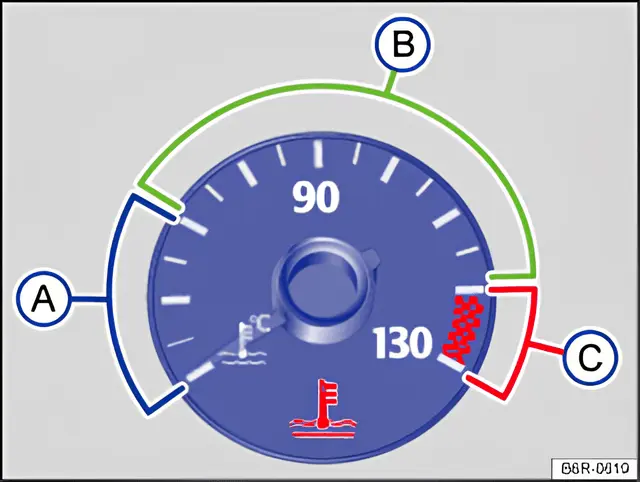
Fig. 140 Coolant temperature display in the instrument cluster: A cold; B normal; C warning
First read and observe the introductory information and safety warnings .
A display for the coolant temperature may be, depending on the vehicle equipment, located in the instrument cluster. In normal driving conditions, the needle will be in the middle section of the scale. The temperature may also rise when the engine is working hard, especially at high ambient temperatures.
| Flashes | Needle position ⇒ fig. 140 | Possible cause | Solution |
|---|---|---|---|
C Warning area | Coolant temperature too high. | Do not drive on! Stop the vehicle as soon as possible, and when safe to do so. Stop the engine, let the engine cool down until the needle is back in the normal area. Check the coolant level ⇒ Checking the coolant level. | |
B Normal area | Coolant level too low. | After the engine has cooled down, check the coolant level and refill engine coolant if the level is too low ⇒ Refilling coolant. There is a fault if the coolant level is correct. | |
– – | Fault in the coolant system. | Do not drive on! Seek expert assistance. | |
| – – | A Cold | – – | Avoid high engine revs and heavy engine loads until the engine is warm. |
| Lit up | Possible cause | Solution |
|---|---|---|
| Engine coolant temperature is too low in vehicles with an autogas engine. | Avoid high engine speeds and heavy engine loads. Wait until adequate operating temperature has been reached. |
Several warning and indicator lamps will light up briefly as a functional check when the ignition is switched on. They will switch off after a few seconds.
Coolant specification
Section titled “Coolant specification”First read and observe the introductory information and safety warnings .
The cooling system is filled at the factory with a mixture of specially prepared water and at least 40% coolant additive G 13 (TL-VW 774 J). The coolant additive is dyed purple. This mixture of water and coolant additive gives the necessary frost protection down to -25°C (-13°F) and protects the alloy parts of the cooling system against corrosion. The mixture also prevents scaling and raises the boiling point of the coolant.
In order to protect the coolant system, the proportion of coolant additive must always be at least 40%, even if anti-freeze is not required in warm weather and warm climates.
If greater frost protection is required in very cold climates, the proportion of anti-freeze additive can be increased. However, the percentage of coolant additive should not exceed 60%, as this would reduce the frost protection and the cooling effect.
When topping up the coolant, a mixture of distilled water and at least 40% coolant additive - G 13 - or - G 12 plus-plus - (TL-VW 774 G) (both of which are dyed purple) must be used in order to obtain the optimum corrosion protection ⇒ . Mixing - G 13 - with the coolant additives - G 12 plus - (TL-VW 774 F), - G 12 - (dyed red) or - G 11 - (dyed blue-green) will significantly decrease the level of corrosion protection and should therefore be avoided ⇒ .
Coolant and coolant additives can pollute the environment. Spilt operating fluids must be collected and disposed of properly and with respect for the environment.
Checking the coolant level and refilling coolant
Section titled “Checking the coolant level and refilling coolant”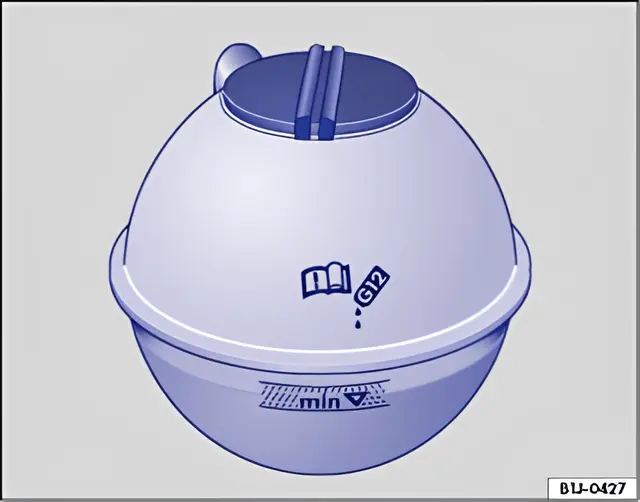
Fig. 141 In the engine compartment: mark on the coolant expansion tank
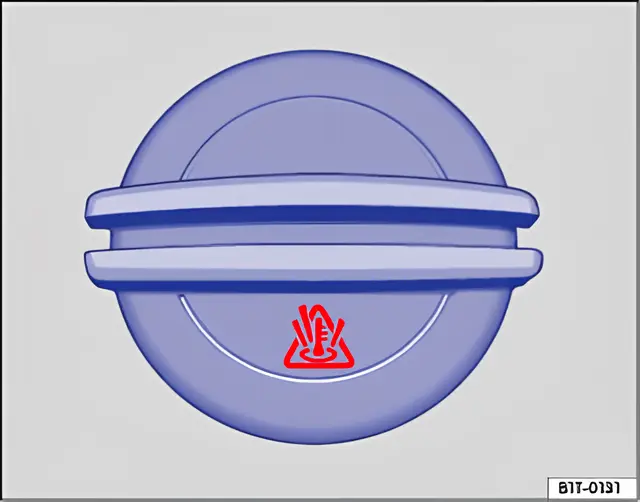
Fig. 142 In the engine compartment: coolant expansion tank cap
First read and observe the introductory information and safety warnings .
The warning lamp for the engine coolant will light up if the engine coolant level is too low.
Preparation
Section titled “Preparation”- Park the vehicle on a firm and level surface.
- Allow the engine to cool down ⇒ .
- Open the bonnet ⇒ Opening and closing the bonnet.
- The coolant expansion tank has the symbol on its cap ⇒ fig. 142.
Checking the coolant level
Section titled “Checking the coolant level”- Check the coolant level at the side marking of the expansion tank when the engine is cold ⇒ fig. 141.
- Refill the coolant if the liquid level is below the minimum marking (min). When the engine is warm, the coolant level may be slightly above the top end of the marked area.
Refilling coolant
Section titled “Refilling coolant”- Always protect your hands and arms from hot coolant or steam by placing a suitable cloth on the cap of the coolant expansion tank.
- Unscrew the cap carefully ⇒ .
- Refill only new coolant according to the Volkswagen specification ⇒ Coolant specification.
- The coolant level must be between the marks on the expansion tank ⇒ fig. 141. Do not fill up over the top line of the marked area ⇒ !
- Close the cap tightly.
- If in an emergency you do not have access to the coolant of the required specification ⇒ Coolant specification, do not use any other coolant additive. Instead, initially refill with distilled water only ⇒ . Then add the correct proportion of coolant additive as soon as possible.
Useful links: