Starting the engine with jump leads
Introduction
Section titled “Introduction”This chapter contains information on the following subjects:
If the engine fails to start because the vehicle battery is flat, the flat battery can be connected to the battery of another vehicle to start the engine. Before using jump leads, check the window on the vehicle battery.
Jump leads must comply with DIN 72553, see manufacturer’s documentation. The wire cross section must be at least 25 mm² for petrol engines and at least 35 mm² for diesel engines.
Additional information and warnings
Section titled “Additional information and warnings”- Pull-away assist systems (start/stop system)
- Preparation for working in the engine compartment
- Battery
- Tow-starting and towing
Positive and earth jump lead connection points
Section titled “Positive and earth jump lead connection points”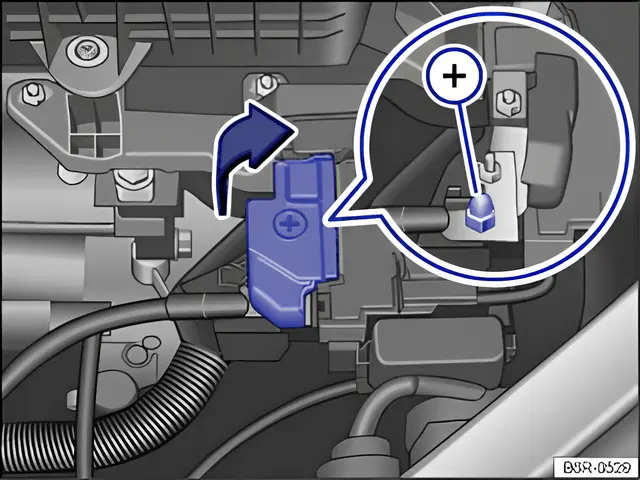
Fig. 192 In the engine compartment: jump lead connection point, positive +
First read and observe the introductory information and safety warnings .
The positive jump lead connection point ⇒ fig. 192 + is in the engine compartment. In order to establish a suitable earth connection, screw the towing eye into the front mounting provided for this purpose ⇒ Tow-starting and towing.
The vehicle can only be jump-started or be used to jump-start another vehicle via these jump lead connection points.
How to start the engine using jump leads
Section titled “How to start the engine using jump leads”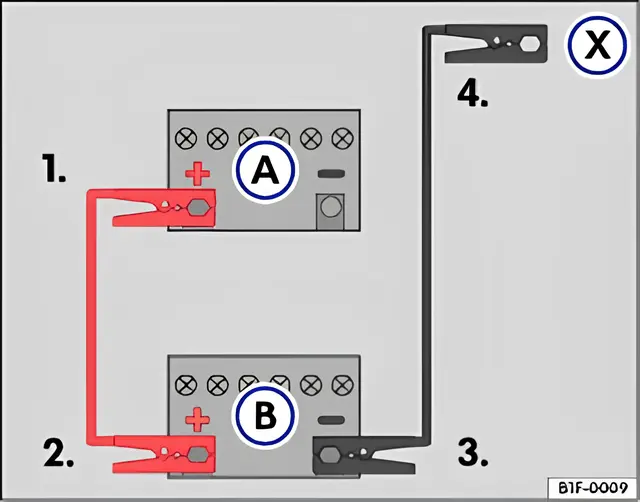
Fig. 193 How to connect the jump leads when starting vehicles without start/stop system: discharged battery A and battery providing assistance B
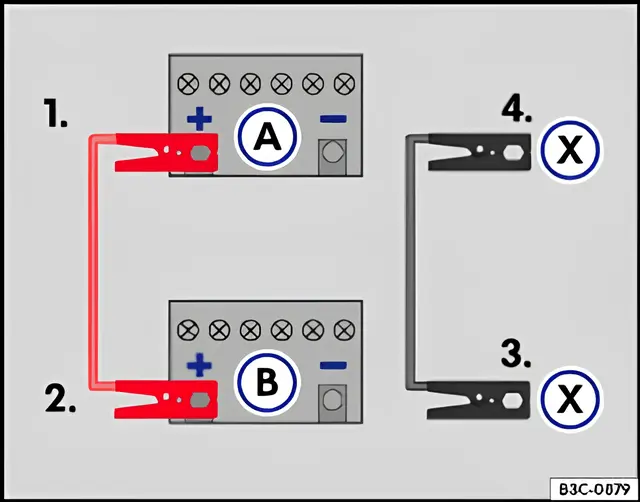
Fig. 194 How to connect the jump leads when starting vehicles with start/stop system: discharged battery A and battery providing assistance B
First read and observe the introductory information and safety warnings .
A Vehicle with discharged battery that is being jump-started.
B Vehicle with vehicle battery that is supplying power and jump-starting the other vehicle.
X Suitable earth connection. A solid metal part that is firmly bolted to the engine block, the engine block itself or, where fitted, the screwed-in towing eye at the front ⇒ Tow-starting and towing.
The discharged vehicle battery must be properly connected to the vehicle’s electrical system.
The vehicles must not touch. Otherwise electricity could flow as soon as the positive terminals are connected.
Ensure that the battery clamps have good metal-to-metal contact with the battery terminals.
If the engine does not start immediately, switch off the starter after about 10 seconds and try again after about half a minute.
The steps should only be carried out in the specified order.
Attaching the jump leads
Section titled “Attaching the jump leads”- Switch off the ignitions in both vehicles.
- Open the battery cover (if there is one) in the engine compartment or open the cover of the positive jump lead connection point.
- Connect one end of the red jump lead to the positive terminal ⇒ fig. 193 + or ⇒ fig. 194 +, or to the jump lead connection point ⇒ fig. 192 of the vehicle with the discharged battery A ⇒ .
- Connect the other end of the red jump lead to the positive terminal + in the vehicle providing assistance B.
- In vehicles without start/stop system: connect one end of the black jump lead X to the negative terminal – in the vehicle providing assistance B ⇒ fig. 193.
- In vehicles with start/stop system: connect one end of the black jump lead X to a suitable earth connection, to a solid metal part that is securely bolted onto the cylinder or to the cylinder block itself ⇒ fig. 194.
- Connect the other end of the black jump lead X to a solid metal component that is bolted firmly to the engine block of the vehicle with the flat battery, to the engine block itself or, if necessary, to the screwed-in towing eye at the front. Do not connect it to a point near the battery A ⇒ .
- Position the leads in such a way that they cannot come into contact with any moving parts in the engine compartment.
Starting the engine
Section titled “Starting the engine”- Start the engine of the vehicle providing assistance and let it run at idle.
- Start the engine of the car with the discharged vehicle battery and wait two or three minutes until the engine is running smoothly.
Removing the jump leads
Section titled “Removing the jump leads”- Before disconnecting the jump leads, switch off the dipped beam headlights if they are switched on.
- Turn on the heater blower and rear window heater in the vehicle with the discharged battery. This helps minimise the voltage peaks generated when the leads are disconnected.
- With the engines running, disconnect the jump leads in the exact reverse order to the instructions given above.
- Close the vehicle battery cover.