Preparation for working in the engine compartment
Introduction
Section titled “Introduction”This chapter contains information on the following subjects:
Always park the vehicle on a level and stable surface before carrying out any work in the engine compartment.
The engine compartment of a motor vehicle is a hazardous area. Never carry out any work on the engine or in the engine compartment if you are not familiar with the requisite procedures and general safety requirements, or if you only have access to incorrect operating equipment, service fluids, and unsuitable tools ⇒ . The work should be carried out by a qualified workshop if you are uncertain. Serious injuries can be caused if work is carried out incorrectly.
Additional information and warnings
Section titled “Additional information and warnings”- Exterior views
- Windscreen wiper/washer
- Starting and stopping the engine
- Brake fluid
- Checks when filling the tank
- Engine oil
- Engine coolant
- Battery
- Accessories, modifications, repairs and renewal of parts
Service fluids leaks are harmful to the environment. So you should regularly check the ground underneath your vehicle. If there are spots of oil or other fluids on the ground, the vehicle should be inspected by a qualified workshop. Any spilt service fluids must be disposed of properly.
Preparing the vehicle for working in the engine compartment
Section titled “Preparing the vehicle for working in the engine compartment”First read and observe the introductory information and safety warnings .
Checklist
Section titled “Checklist”The following steps should always be carried out in the specified order before working in the engine compartment ⇒ :
- Park the vehicle on a level and stable surface.
- Depress and hold the brake pedal until the engine has stopped.
- Apply the handbrake firmly ⇒ Handbrake
- Select the neutral position or move the selector lever to P ⇒ Changing gear
- Stop the engine and remove the key from the ignition ⇒ Ignition lock
- Allow the engine to cool sufficiently.
- Children and other people should be kept well away from the engine compartment.
- Ensure that the vehicle cannot roll away unexpectedly.
Opening and closing the bonnet
Section titled “Opening and closing the bonnet”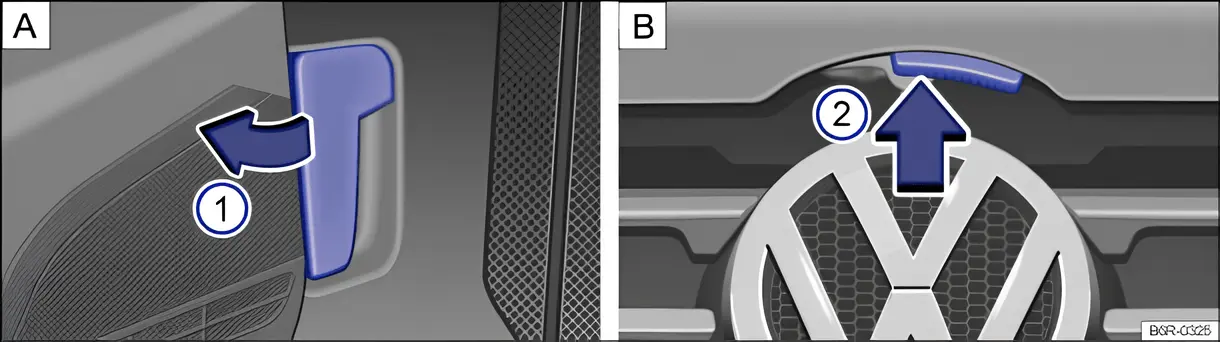
Fig. 136 A: release lever in the footwell on the driver side. B: release lever on the bonnet
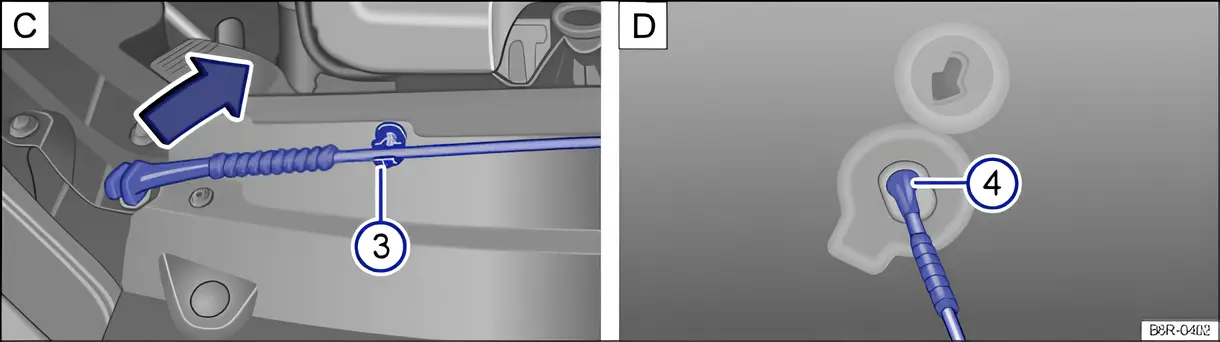
Fig. 137 C: holder for the bonnet stay in the lock carrier. D: bonnet secured with the bonnet stay
First read and observe the introductory information and safety warnings .
Opening the bonnet
Section titled “Opening the bonnet”- Ensure that the windscreen wiper arms are positioned on the windscreen before opening the bonnet ⇒ .
- Open the driver door and pull the release lever in the direction of the arrow ⇒ fig. 136 1. The bonnet is released from its lock by a spring mechanism ⇒ .
- Lift the bonnet slightly and at the same time push the release lever in the direction of the arrow 2 to open the bonnet completely.
- Take the bonnet stay out of the holder in the direction of the arrow ⇒ fig. 137 3 and hook it into the opening in the bonnet 4.
Closing the bonnet
Section titled “Closing the bonnet”- Lift the bonnet slightly ⇒ .
- Unhook the bonnet stay out of the opening 4 and insert it in the holder 3.
- Let the bonnet drop into the catches from a height of approximately 30 cm - do not press it down!
If the bonnet is not closed, open it again and close it properly.
The bonnet sits flush with the body parts around it when it is closed properly.