Starting and stopping the engine
Introduction
Section titled “Introduction”This chapter contains information on the following subjects:
Notes in this chapter concerning the automatic gearbox are applicable both for the automatic gearbox and the dual clutch gearbox DSG®.
Immobilizer display
Section titled “Immobilizer display”If the vehicle key is not valid or there is a fault in the system then Immobilizer active! may be displayed in the instrument cluster. The engine cannot be started.
Push starting or tow starting
Section titled “Push starting or tow starting”For technical reasons, your vehicle must not be push-started or tow-started. Use jump leads to start the engine instead.
Additional information and warnings
Section titled “Additional information and warnings”- Vehicle key set
- Changing gear
- Braking, stopping and parking
- Steering
- Pull-away assist systems
- Filling the tank
- Fuel
- Manual opening and closing
- Starting the engine with jump leads
- Tow-starting and towing
Ignition lock
Section titled “Ignition lock”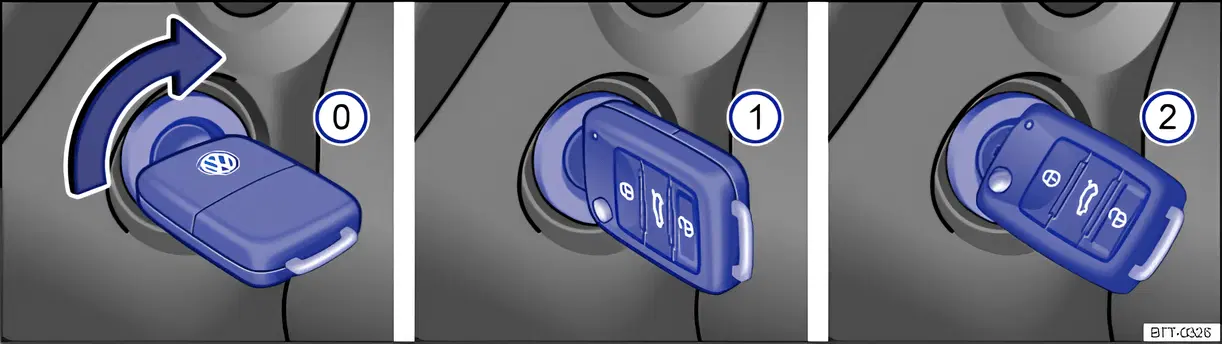
Fig. 109 Positions of the vehicle key in the ignition lock
First read and observe the introductory information and safety warnings .
The steering lock can be activated when there is no vehicle key in the ignition lock.
Vehicle key positions ⇒ fig. 109
- Ignition switched off. The vehicle key can be removed.
- Ignition switched on. The steering lock can be released.
- Engine is started. Release the vehicle key as soon as the engine starts. Once released, the vehicle key moves back to position 1.
The steering should be locked every time you leave the vehicle to make theft of the vehicle more difficult ⇒ Mechanical steering column lock.
Non-authorised vehicle key
Section titled “Non-authorised vehicle key”If a non-authorised vehicle key has been inserted in the ignition lock it can be pulled out as follows:
- Automatic gearbox: the vehicle key cannot be removed from the ignition in this position. Press the lock button in the selector lever and release ⇒ fig. 113 or ⇒ fig. 114. The vehicle key can be removed.
- Manual gearbox: remove the vehicle key from the ignition lock.
If the vehicle key is left in the ignition for a long period with the engine switched off, the vehicle battery could discharge.
In vehicles with an automatic gearbox, the vehicle key can only be removed from the ignition lock if the selector lever is in position P. If necessary, press the lock button in the selector lever and then release it.
Starting the engine
Section titled “Starting the engine”The steps should only be carried out in the specified order.
First read and observe the introductory information and safety warnings .
| Step | Vehicles with a manual gearbox | Vehicles with an automatic gearbox |
|---|---|---|
| 1. | Press the brake pedal. Keep it held down until step 5 has been completed. | |
| 1a. | Fully depress the clutch pedal until the engine has been started. | — |
| 2. | Shift the gear stick to a neutral position. | Shift the selector lever to position P or N. |
| 3. | Only vehicles with diesel engines: to preheat the engine, turn the vehicle key to position ⇒ fig. 109 1. The indicator lamp in the instrument cluster lights up. | |
| 4. | Turn the vehicle key in the ignition lock to position ⇒ fig. 109 2 - do not depress the accelerator. | |
| 5. | Release the vehicle key once the engine has started. | |
| 6. | If the engine does not start, stop the procedure and repeat it after approximately one minute. | |
| 7. | Release the handbrake if you wish to pull away ⇒ Braking, stopping and parking. | |
Do not warm up the engine by running it while the vehicle is stationary. Instead, pull off as soon as there is good visibility through the windows. This helps the engine to reach operating temperature more quickly and reduces emissions.
Components with a high power consumption are switched off temporarily when the engine is started.
When starting from cold, the engine may be a little noisy for the first few seconds. This is quite normal, and no cause for concern.
Stopping the engine
Section titled “Stopping the engine”First read and observe the introductory information and safety warnings .
| The steps should only be carried out in the specified order | |
|---|---|
| 1. | The vehicle must be completely stationary ⇒ |
| 2. | Press the brake pedal. Keep it held down until step 4 has been completed. |
| 3. | In an automatic gearbox, move the selector lever to position P. |
| 4. | Apply the handbrake firmly ⇒ Braking, stopping and parking. |
| 5. | Turn the vehicle key to position ⇒ fig. 109 0. |
| 6. | In vehicles with a manual gearbox, select first gear or reverse. |
In vehicles with an automatic gearbox, the vehicle key can only be removed from the ignition lock if the selector lever is in position P.
After the engine is switched off, the radiator fan in the engine compartment may run on for some minutes, even if the ignition is switched off or the vehicle key has been removed. The radiator fan will switch itself off automatically.
Electronic immobilizer
Section titled “Electronic immobilizer”First read and observe the introductory information and safety warnings .
The immobilizer helps to prevent the engine from being started and driven with an unauthorised vehicle key.
There is a chip in the key. It automatically deactivates the immobilizer when the vehicle key is inserted into the ignition lock.
The electronic immobilizer is automatically activated when the vehicle key is removed from the ignition lock.
The engine can only be started using a genuine Volkswagen vehicle key with the correct code. Coded vehicle keys are available from a Volkswagen dealership ⇒ Replacement key.
If a non-authorised vehicle key has been used, the display in the instrument cluster will show Immobilizer active! The vehicle cannot be used if this occurs.
The vehicle cannot be operated properly if you do not have a genuine Volkswagen key.